


Wartime allotments in Stainland
Some time ago somebody asked the question “how old are Drury Lane allotments in Stainland” The short answer is that they are over 100 years old and are one of many allotments created during World War One. However, this question rather predictably sent me down a research rabbit hole, where I looked more into the history of this allotment, the people who first kept plots there and other wartime allotments in the area.

Allotments are small plots of land rented primarily to grow fruit and vegetables. The 1845 Enclosures Act legislated for field gardens to be provided for the landless poor and the Smallholdings and Allotments Act of 1908 established a legal framework for the provision of allotments by local authorities.
The 1908 allotment act states that if allotment authorities 'are of the opinion that there is a demand for allotments in the borough, district or parish the council shall provide a sufficient number of allotments to persons resident in the borough district or parish and desiring the same'. In determining demand an authority must take into consideration 'a representation in writing by any six registered parliamentary electors or rate payers'.
This act gave local authorities the power to compulsory purchase land for allotments if they could not be acquired by private agreement and gave allotment authorities permission to make improvements to the land such as creating drainage and paths.
An allotment was defined as ‘any parcel of land whether attached to a cottage or not of not more than two acres, held by a tenant under a landlord and cultivated as a farm or a garden or partly as a garden and partly a farm.’ They are usually divided into several smaller plots or gardens.
There have been several allotment acts since, which were largely aimed at providing plot holders some security of tenure.

July 1914 saw the outbreak of World War One and fears over food shortages resulted in a drive towards self sufficiency, which included cultivation of unused land and the provision of allotments.
Stainland Urban District Council (UDC) minutes provide us with lots of detail about the provision of allotments in the area. The first mention we find in the minutes are at the end of 1916. In October a letter was read from the West Riding District Councils Association stating that a conference was being convened to consider what measures can be taken by local authorities to promote the establishment or increase the productiveness of allotments.
Two months later the minutes of 28th December 1916 state that;
‘A letter dated 7th December was read from the West Riding County council referring to a recent speech of Lord Crawford’s and to a resolution passed at the conference convened by the District Councils Association strongly urging that urban councils should utilise all available land and waste land for food production and to provide allotments wherever possible….
Resolved that the whole council be formed into a war agricultural committee and the committee have the power to provide allotments and take such steps in the matter as they deem necessary’
In March 1917 there are several references to applications for allotments and surveying of land. Councillor Schofield was to cut the first sod at a new allotment site. Unfortunately, it is unclear from the minutes exactly where these plots were but there are later references to allotments at the Duke of York so it may well have been these.
In August 1917 the Halifax Guardian reported on an allotment holders prize event held in Stainland. It states that there are 17 allotments connected to the Council but 80 or 90 gardens altogether in the district.

In October 1917 we see the first reference to allotments at both Sowood and at Drury Lane -
Stainland Urban District Council Minutes 25th October 1917;
‘There being an application for further allotments in Stainland & Sowood & a field at Drury Lane belonging to Mr Fred Briggs being suitable for the purpose. Resolved that arrangements be made with Mr Briggs to take the field from him on terms to be arranged’
The acquisition of allotments at Sowood appears to have been quite complicated as the land had to be taken by the council. The council was empowered to seize land for food production under the 1917 cultivation of lands order, an emergency wartime measure that was introduced under the Defence of the Realm Act when it was feared that German U Boat blockades and the destruction of merchant shipping routes could lead to severe food shortages and starvation.
25th October 1917
“Re allotments at Sowood. That the Clark write to the West Riding Council and inform them that four fields viz Nos 942, 802, 874 and 881 have been suggested as fields for allotments and all are occupied and as to the consent of that council is necessary to the taking of such land they be requested to send over an inspector to inspect the various fields and the Chairman and Surveyor do meet him.”
The creation of allotments at Drury lane was much more straight forward. On 27th December 1917 the minutes report that agreements for Drury Lane had been drawn up and sealed. Thirteen plots had been allocated; each plot being 300 meters with an annual rent of 8 shillings. The minutes helpfully list the names and addresses of all the allotment holders. They were:
1. S J Furness – Drury Lane
2. Ben Whiteley – Well Head
3. Joseph Tiplady – Gardeners cottage
4. GW Iredale Westgate
5. John Hirst Thorn St
6. Leonard Ellis – Town Ing Mills
7. William Jowett – Shepherds cottage
8. B. Priestley – Gladstone St
9. N Thwaite – Priors Terrace
10. Edwin Park – Towngate
11. Joseph Tiplady – gardeners cottage
12. Alfred Thorpe – Drury Lane
13. Fred Bolton – Drury Lane

From the 1921 census I was able to find out some information about the allotment holders including other household members and their occupations. The vast majority of people were born in Stainland and worked in the local area, many of them in the woollen industry.
Fred Bolton lived on Drury Lane. In 1921 he was aged 55 and a self employed boot repairer working from home. He lived with his wife Martha and their three sons;
Kenny, (27) an engines man at Haigh, Wright & Co woollen manufacturers (Firth House Mills, Stainland), Walter (23) unemployed and Edgar (15) bobbin winder at Floral House Mills Stainland
Also living there was Fred’s brother in law John Shaw (55) – a cow man at Branch farm, Greetland.
Another family living on Drury Lane was James Furness (49) plaster and painter. He was working for Seth Collins and Sons at Well Head, Stainland. He lived with his wife Edith (47), their son Selwyn (20) a post clerk at Martin Sons, cloth manufacturers on Pellon Lane, Halifax, daughter Florence (18) a cotton frame tenterer at B Taylor & Co at Barkisland Mill and son Wilfred (16) sheet metal worker at Harrison & Allott, Bull Green, Halifax.
Edwin Parke (52) of Towngate was a life assurance agent at Refuge Assurance Co. Ltd. His place of work is described as ‘home’. He lived with his wife Rose Alice. She was born in Hollingwood, Lancashire (near Oldham). Also living with them was their 23 year old son Willie, a shop assistant at Stainland & Holywell Green Co-operative society.

Alfred Thorpe of Drury Lane (49) was a cotton doubler for James Rothwell, cotton manufacturer at Holywell Mills. His wife was called Sarah Thorpe (48) Their children were Willie Thorpe (17) woollen weaver for John Sutcliffe at Town Ing Mills, Stainland, Daughters Dorris (22) woollen weaver for John Sutcliffe at Town Ing Mills, Stainland and Edith 15 , laundry maid, Chas & Rothwell, Holywell Green.
Joseph Tiplady - When he took the allotment he lived at Gardener’s cottage but by 1921 he had moved to 18 Chapel St. Aged 52, he was a tramways labourer for Halifax Corporation. Originally, he was from Howden and lived with his wife Sarah Ann and their five children who were all born in Barnsley. The four older children (aged between 16 and 23) all worked in the woollen industry for J&S Taylor at Bowers Mill, Barkisland.
William/ Willie Jowett (52) lived at Shepherd’s cottage. He was a supervising road man for Stainland Urban District Council. He lived with his wife Eliza and 18 year old daughter Evelyn May who was a wool winder at Dog Lane Mills.
Shepherds and Gardeners cottages were next to each other between New Street and Grey Hall.
Ben Whiteley of Well Head, Stainland was born in Stainland. He was a newsagent at Well Head and lived with his wife Martha and their three sons. The eldest son Fred (23) was an architects assistant, 18 year old Ernest was an electrical engineers apprentice and 16 year old Henry was described as help at home and working for father so he likely worked in the newsagent. The eldest son Fred had been conscripted to the Tank Corps in WW1 aged 18. He went on to become an architect, living in Doncaster until his death in 1962.
GW Iredale of Westgate was a little harder to find as by 1921 he had died. His widow was Alice Iredale, age 47. She was working at Founding Mills Stainland as a worsted mender and lived with their 12 year old daughter Mabel. Her husband was George Wright Iredale who died in 1920. I couldn’t find anything in the minutes to say whether she carried on the allotment (technically under the 1908 allotment act women could have allotments if they were rate payers. Women rate payers were often widows who had taken over payment of rent and rates following the death of the husband) However, in 1925 a J. E. Iredale won a number of prizes at the Stainland Allotment Association vegetable show. J. E. Iredale was John Eli – brother of George – so looks like his brother took over allotment rather than his wife.

John Hirst of Thorn Street was a percher of pieces ( a textile worker who inspects the cloth) at John Shaw & Sons (Brookroyd Mill, Holywell Green). He lived with his wife Emily and their three adult children. Harold (29) a woollen piecer at Bowers Mill, Annie (26) cloth mender at Brookroyd and Edna (24) worsted weaver at Town Ing Mills.
B Priestley - Gladstone Street. There were several Priestley’s who look to be related living on Gladstone Street (3 of 7 houses!) This was likely Benjamin Priestley who was a self employed mason/ builder. He lived with his wife Sarah Amy. It may be that he shared the allotment with other family members.
Norman Thwaite (36) of Prior Terrace was a hairdresser at Ellistones, Stainland. He was living with his wife Ethel. Norman was one of at least eight children who lived at spring terrace. He was baptised at St Andrews but not until he was 15 years old and at the same time as several of his siblings. Ethel was also from a large Stainland family - the Briggs. They were grocers and corn dealers and lived on Towngate. Norman died in 1927 and Ethel looks to have carried on the hairdressing business as on the 1939 register she was still living at Prior Terrace and her occupation was hairdresser.

Once the allotments had been established at Drury Lane we only find occasional mentions of them in the minutes;
February 1920 – damage to allotments caused by Mr G. Collins fowl trespassing both on Drury Lane and Duke of York Allotments.
September 1920 – agreed that 6 pence per annum be paid to Harriet Sutcliffe as easement for connection to her water service for water supply for Drury Lane allotments.
On the 1921 census Harriet was living at Drury Lane. She was aged 50 and widowed. She was living with her two adult children Clement (21) and Doris (19). They were both working at John Sutcliffe Woollen Manufacturing at Town Ing Mills in Stainland. From earlier census records we can see that Harriet’s husband was called John and a woollen manufacturer/ employer. They were actually living at Beestones Mill in 1911. Presumably her children were working at the family business and Harriet was head of the house and paying the rates at Drury Lane, hence the allotments paying her for use of the water.
By looking at electoral registers we can confirm that Harriet was the head of the household as she was eligible to vote in both local and parliamentary elections under the occupation/ property qualification which allowed some women over the age of 30 the right to vote under the Representation of the People Act 1918; whereas her son Clement was eligible to vote under the residence qualification once he reached age 21.
Census records for this period rarely have house numbers but they are usually recorded in the order the enumerator walked. As Harriet is the first entry under Drury Lane and she is supplying water to the allotments we can assume that she probably lived at the house at the bottom of the lane closest to the allotments.
In 1939 Harriet was still living at Drury Lane. Her occupation is described as private means (which means she has some money of her own but is not working) and she was living with Emma Sutcliffe who is described as a ladies companion and is also a widow. Emma was likely a relative by marriage of Harriet. Harriet died in 1942 and is buried at Providence Methodist Cemetery in Stainland with her husband John.
There are references to other allotments in the Stainland area. There were allotments at Crossfield and at Laneside in Holywell Green. In 1921 two tenants of the Duke of York Allotments, J.A Hanson of Kilncroft and Fred Thompson, New St were named and shamed in the minutes for ‘breach of agreement requiring the keeping of allotments free from weeds, well manured and maintained in a satisfactory manner’. They were given notice to quit.
There were also occasional mentions of allotments in local newspapers. In 1920 allotment holders in Stainland were warned against planting potatoes of the eclipse and true early varieties because of the spread of potato wart in the UK. Potato wart or canker is a fungal disease that lives in the soil and causes large wart like growths on potatoes. It was first identified at the end of the 19th century and spread rapidly across Europe and the UK. By 1920 there were serious concerns that it could impact food supply and so where it was suspected that the pathogens were present in the soil the Ministry of Agriculture ordered farmers and allotment growers not to plant susceptible varieties. There has since been much research into breeding wart resistant varieties of potato.

Following the end of World War One, there was less demand for allotments in the area. On 19th January 1926 the surveyor reported that tenants were not forthcoming for allotments and more would be unoccupied next year.
In 1930 there is reference to a circular from the Ministry of Agriculture and Fisheries about allotment gardens for unemployed persons. It was discussed at length but no action taken. This was a government scheme designed to help unemployed men provide for themselves and their families as the interwar years saw growing unemployment and hardship.
We don’t find any more mentions of Stainland allotments for the next few years and in 1937 Stainland Urban District Council became part of Elland UDC. However, following the outbreak of World War Two in 1939 we again see a push towards self sufficiency and use of land for food production with the launch of the Dig for Victory campaign.

On 4th December 1940 there is an interesting entry in Elland UDC minutes:
'Chairman and vice chairman asked to report re the proposed letting of land in Drury Lane, Stainland of which the council were tenants from Mr Thomas Briggs, for the purpose of allotments
Chairman reported re proposed sub letting of land in Drury Lane, Stainland for the purposes of allotments. Allotment association be informed the Council are willing to let land for allotments and to bring matter to notice of the public.'
It is not clear whether this is in addition to the WW1 allotments at Drury Lane or whether they weren’t in fact weren’t being used as allotments at the outbreak of WW2. Presumably Thomas Briggs is the son/ another relative of Fred Briggs who originally rented the council the land for allotments at Drury Lane.
The allotments are marked on this map from 1932 so if they did fall out of use it would only have been for a short period.

The Council were also looking to use Stainland recreation ground to grow crops;
'Also report of corre from Ministry of Agriculture re obtaining permission for land at Stainland Rec to be cultivated notwithstanding the restrictions of the deed. Resolved that the Council invite tenders for the letting of the land for the purposes of growing war time crops thereon and at the expiration of the tenancy the land to be sown down with grass seed'.
Minutes from January 1941 tell us that it was in fact used for crops:
'Response re letting of land at Stainland Rec for growing crops. Received and accepted offer from Mr R B Clegg, dairy farmer of Holywell Green. (£10 per year for three years)' It is not specified what crops were grown but most of the larger areas of land requisitioned in Calderdale seem to have been used for potatoes.
In the World War Two period there are references to further allotments on ‘Stainland Housing Estate’ and at Sowood and Holywell Green.
In 1942, 1943 and 1944 there were large Dig for Victory exhibitions held in Halifax. Various councils including Elland and District (which Stainland was now part of) combined to produce these exhibitions. The events lasted several days and included lectures, films and advice on various aspects of food production, as well as demonstration gardens and competitions.
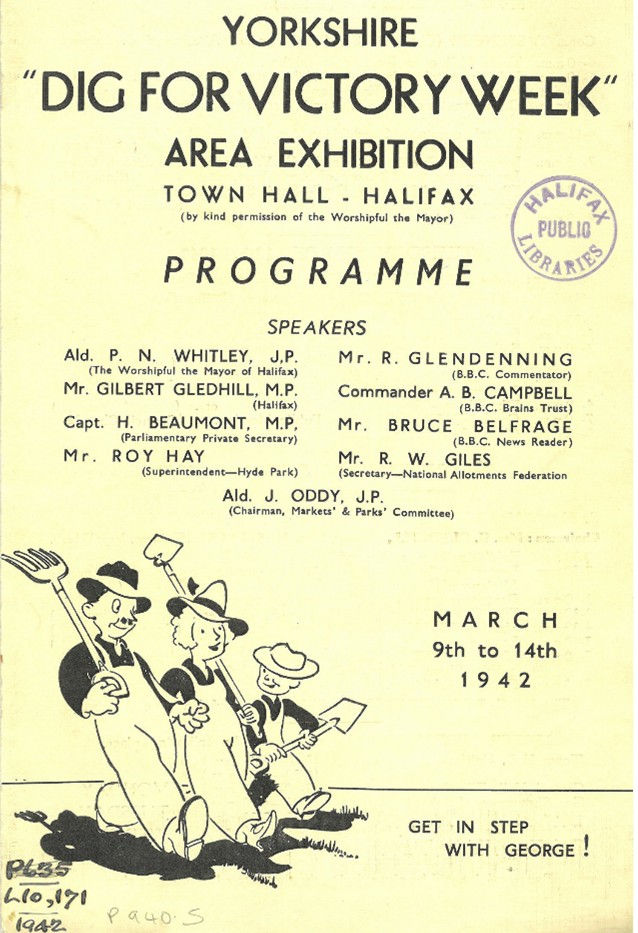

Following the end of World War Two, allotment use again began to decline. A lot of the land that was taken for allotment use was returned to landowners or put back to recreational use (such as Stainland Rec). However the Allotment Act of 1950 secured some land for growing and gave protection to allotment holders.
An end to rationing and the availability of cheaper imported foods also lead to a decrease in the popularity of allotments. I couldn’t find any figures for Stainland but the figures for Todmorden demonstrate a marked decline. In 1945 there were 387 council run allotment plots, in 1951 there were 261 and by 1966 there were 36 statutory allotments and 48 temporary allotments (land held by the Council on lease or on Council owned land not bought for allotments) Of these 48 temporary allotments 32 were occupied and 16 not occupied.
These figures are taken from allotment statistics surveys 1952 – 1973 (Todmorden) compiled from annual returns to the Department of Environment that were required under the smallholding and allotments act 1908. They are held by West Yorkshire Archive Service (Reference CMB/D1/10/7/6)
Of all the WW1 and WW2 council run allotments in the Stainland area, Drury lane is the only one that remains (although there are also a couple of privately run sites in the area). Demand for allotments has increased in the last few years with most sites in Calderdale having significant waiting lists.
In 2023 Drury Lane allotments were transferred from Calderdale Council to Stainland Parish Council and there are now 23 people growing fruit, veg and flowers on the site.




Comments