


Open Access: how our public libraries became properly public
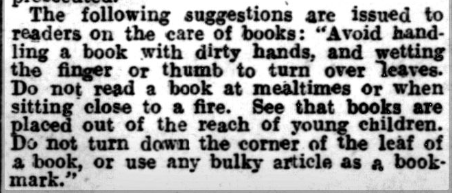
Most "free" or public libraries operated for a long time as closed systems; if you wanted a book, you asked the librarian, who would then fetch it for you and issue it to you under rules that feel impossibly strict to today's library user. One book at a time only; wash your hands before reading; do not read too close to the fireplace; blacklisted from library access if you commit the cardinal sin of lending a library book to a friend!
Multiple complicated methods of keeping track of the books in a library existed, and often in quite insistent competition with each other. We have brochures here in Local Studies for some examples, such as the Cotgreave Library Indicator which "protest[s] against misrepresentation" and gives multiple nationwide testimonies to its usefulness, and Cedric Chivers' Patent Library Indicator whose brochure leans heavily on exclamation points to prove its worth.

Not all libraries operated this way though. When Brighouse Free Library opened in July 1898, it operated under a very different principle – that of open access. Open access is nearer to how we operate today, although still with a level of security that would make you feel as though you were passing through an airport.
A borrower would approach the desk, offer their ticket (card), and ask for access. The librarian would take their ticket and then pull a lever which operated a turnstile, allowing the borrower to enter the stacks. There they would peruse at their leisure before returning to the turnstile to seek an exit, and bring the books to the librarian to issue. Only one borrower could be inside the stacks at any given time. One wonders at the queues that could develop! The newspapers quickly found novelty in the process and an article about the system at Brighouse was keen to repeatedly compare open access to the "antiquated" system at Belle Vue in Halifax.

Open access meant that borrowers borrowed more books, as would later be shown as other large libraries followed suit. Belle Vue, Elland, Sowerby Bridge and others began to change their ways, and immediately saw their figures jump. A study of 60 libraries conducted in 1908 found that those using libraries with open access systems borrowed 38% more books per year than those using libraries with indicator systems. Of course there were those who argued it would lead to books becoming dirty, or going missing, or even becoming disease vectors, as one Blackpool doctor alleged that same year.

Fears were generally unfounded though and by 1924 all the libraries in what is now Calderdale were converted to open access...apart from one. It's only fitting that this August, the 130th anniversary of the laying of Todmorden Library’s cornerstone, that we mention Todmorden’s temporary but nationally embarrassing reluctance to adopt an open access system.

In 1929 a £500 Carnegie Trust grant was offered to the library for the purchase of additional book stock, but with a catch – the library must adopt the open access system. Todmorden was the final holdout in this area and despite the Library Committee's recommendation that open access be adopted and the grant accepted, the Town Council voted 10-9 against it, deferring it for a year even with the understanding that it meant the grant money would be lost. The meeting was fraught, with Library Committee chairman William Egerton later described as figuratively having "took off his coat" due to the fervour of his arguments in favour of open access. The primary issues were about costs going forward and whether or not the public could be trusted to handle the precious books, with evidence of the success and viability of open access libraries ignored in favour of contradictory negative arguments. The people of Todmorden were already borrowing more books than many in areas where open access libraries had existed for some time; so why give them more opportunities to choose books? Strange to be accused of being untrustworthy and well-read, but it was convincing enough for the resolution to fail.

Convincing to councillors, anyway...but not to the wider world. This debacle led to the Library Association Record writing in June 1929 that "The Todmorden Library Committee and Todmorden Council have banished themselves into the blackness of the mediaeval world by refusing to adopt open access, in spite of the sound and spirited protest of the Chairman of the Library Committee (Coun. Egerton) who had the wisdom to dissent from the verdict of his colleagues". Harsh words from a national journal! They were followed by the Local Government Chronicle in January 1930 referring to Todmorden as "thirty years behind the time".

In between the censure from these two national organs, nearly every weekly edition of the Todmorden Advertiser included a letter about open access, and almost every single one in favour of it. One letter argued that the majority of the books which were borrowed from the library currently were works of fiction, and this was clearly because borrowers weren't able to appreciate the breadth of nonfiction stock which open access would allow them to discover!
When the deferred vote came back to the councillors in February 1930, they had learned their lesson, and extended open access not just to Todmorden but to the branch libraries at Cornholme and Walsden. There were still objectors, but this time they were outnumbered. From October 1930 open access had been accomplished. Todmorden had left the dark ages behind.

The one-in-one-out method of open access was dropped over time, although some readers may remember the turnstiles at the old Central Library at Northgate House in Halifax. Turnstiles installed in a brand-new building in 1983, despite said building obviously being built with the capacity for hundreds of borrowers to turn up at once - one last relic of this particular developmental stage of public library provision.


Comments