


A History of Public Health and Hospitals in Halifax
2026 marks 130 years since the opening of the Royal Halifax Infirmary on Free School Lane, but the provision of free healthcare goes back much further.
At the beginning of the 19th century Halifax was becoming increasingly industrialised with a growing population of around 65,000 inhabitants. Many workers were crushingly poor, living in overcrowded housing with poor sanitation, rife with disease. Many jobs were dangerous and injuries common. Living nearby were numerous wealthy landowners, merchants and manufacturers.
There was no free healthcare or medicine, so treatment was limited to those who could afford to pay for it.
In 1807 the Vicar of Halifax, Reverend Coulthurst held a meeting at the Talbot Inn to discuss the creation of a medical charity for those in need. There was discussion about what form the care should take. It was decided that the erection of a building to house a hospital/ infirmary was too great, so instead established a dispensary from which advice and treatments could be dispensed to the afflicted poor in their own homes.

The Halifax General Dispensary for the relief of the sick poor opened on 8th February 1808.
The dispensary was initially located on Hatters Close at the top of Causeway but at some point in the early days moved around the corner to Dispensary Walk, into premises owned by the Waterhouse charity.
As the population in Halifax increased, so did demand for healthcare. Initially surgical cases had been treated in the patient’s home but in 1824 a nearby cottage was acquired and in 1825 a surgical ward opened. This allowed patients who had suffered injuries to be admitted without recommendation and receive immediate help.
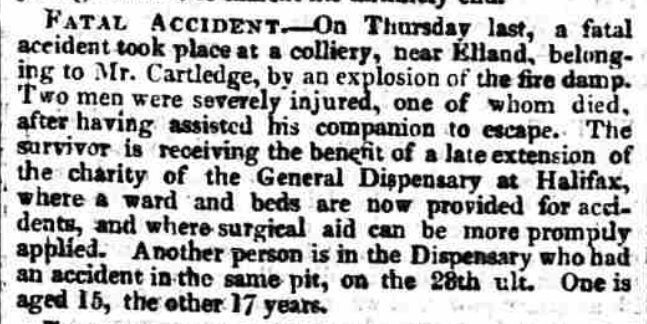
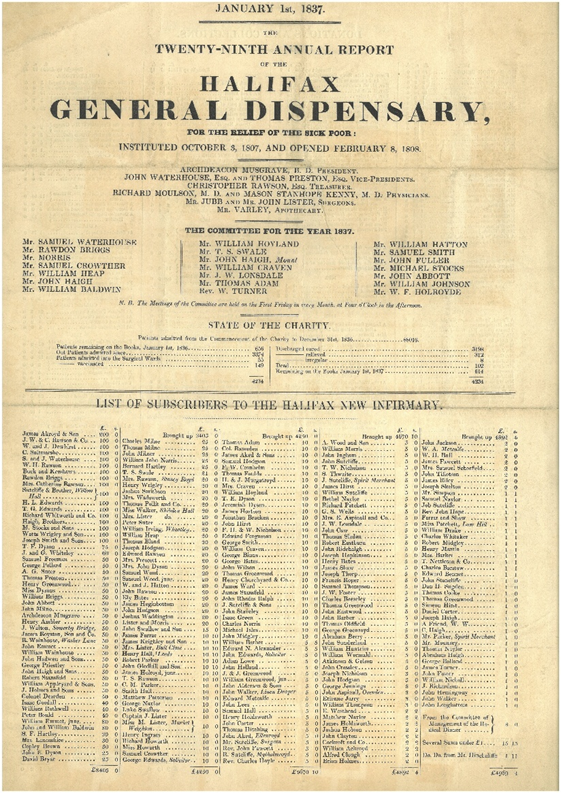
The infirmary was funded primary by subscriptions, with some money also being given from magistrates’ fines, church collections and musical performances. Early treasurers were William and Christopher Rawson.
Subscribers included many local landowners and employers, with James Akroyd & Sons paying the most at £200. Subscribers could recommend people to receive free treatment on the condition that they were ‘absolutely poor and needy and incapable of purchasing medical assistance’. Interestingly menial servants and domestic apprentices could not be admitted as ‘proper objects’ of the charity as their employers were expected to pay for them.

Despite regular subscriptions, the dispensary was spending more money than it brought in, and so efforts were made to raise larger sums of money.
In 1830 Christopher Rawson organised a fund-raising music festival with concerts in the Parish Church, New Assembly rooms and a fancy dress ball at Hope Hall. The festival raised £678 for the dispensary.

The number of people using the dispensary continued to increase. In 1810 1,119 people were treated and by 1836 it was 3,386. Plans were drawn up and money raised for a new, grand dispensary and infirmary.
Anne Lister discussed plans for the new dispensary with both Mr. Jubb (one of the dispensary surgeons) and Rev Musgrave (president of the board.)
She describes the poor sanitary conditions and need for a new building but was also keen that the dispensary would house an anatomical museum:
“had Mr. Jubb near 1/2 hour talked moving the Dispensary — the present situation unhealthy — malaria from the too often used water of a steam engine and common shore — suggested the propriety of ascertaining the line of level of the nuisance, and seeing if it might be possible to put the patients in the garret so as to be above the influence of the noxious vapor — affects those who have wounds does not affect the people in the house who are in health, or have had no surgical operation performed asked if there was any anatomical museum attached to the Dispensary — no! — nor to the philosophical society’s museum — proposed their fitting one up in the council room”
West Yorksire Archive Service SH:7/ML/E/18/0159 (January 1836)
Anne Lister wanted to have her say in the design of the new infirmary:
"Mr. Musgrave called to see my aunt about 2 — I, too, saw him with my aunt and walked to the approach doors with him talking about the new Dispensary — he had just got the plans offered to shew me them — I said I had asked Mr. Harper for a plan of the York county hospital but had been too busy to ask if he had brought it —[margin text:] Mr. Musgrave seemed struck by some of my observations — said perhaps it would be best to throw the thing open to public competition — I said I thought it would be far the best plan.."
West Yorkshire Archive Service SH:7/ML/E/18/0179 (February 1836)
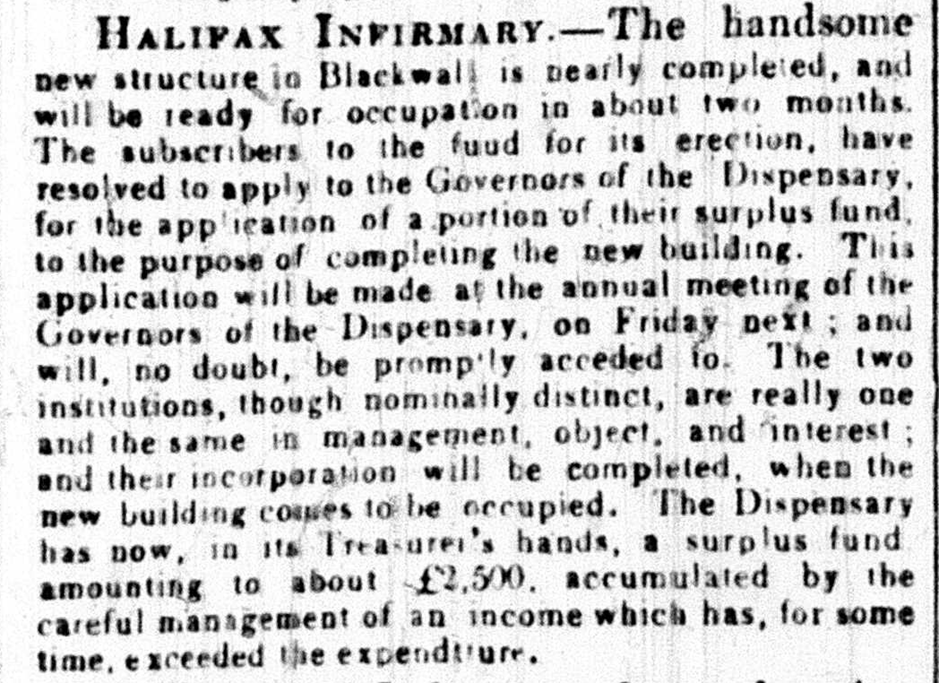
In the end the building was designed by York architect George Townsend Andrews. Located on the corner of Blackwall and Harrison Road; It was opened on 2nd April 1838 and became known as Halifax Infirmary.


The Rules and Regulations of the Halifax Infirmary from 1838 tell us about how the infirmary was run and what life was like for patients. There were to be two physicians, two surgeons and a surgeon dentist as well as an apothecary and a matron. The apothecary was required to be ‘free from the care of a family, take his meals with the Matron and reside constantly in the infirmary.’
The infirmary treated a mixture of out and in patients. Those who were capable (with permission of their surgeon or physician) were expected to help clean the wards and nurse other patients. They also had to provide their own change of linen.
Meals were basic, but in many cases provided more sustenance than they would ordinarily get. Beer was limited with children aged 5 – 8 receiving just 4oz a day!

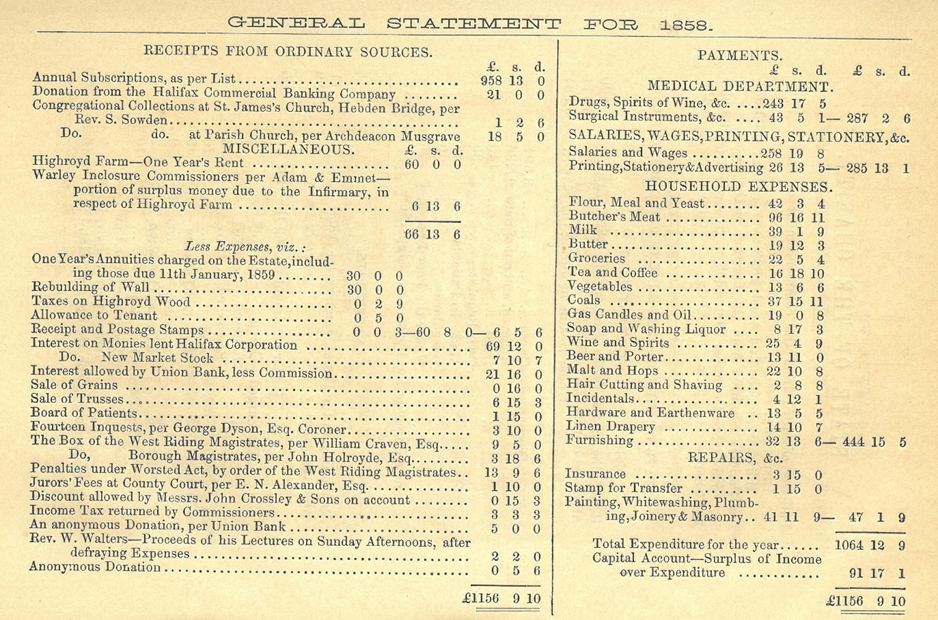
An annual report from 1859 states that from the opening of the infirmary in April 1838 to 31st December 1858; the number of out patients treated was 88,695 and the number of in patients was 3,455.
In 1858 the number of out-patients admitted was 5,531. Of those 3,591 were discharged cured, 1,296 relieved and 143 dead.
It was still funded largely by subscription but also received some substantial bequeaths including £100 from the will of Martha Akroyd (sister of Sir Edward Akroyd)

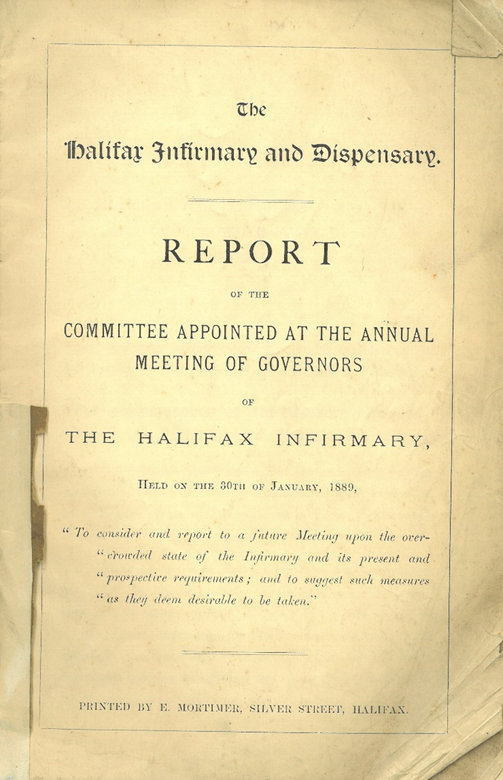
Numbers of patients continued to increase, and the building was enlarged. However, by 1889 a committee was formed to ‘consider the overcrowded state of the infirmary’. The report states that it was so overcrowded as to be ‘productive of serious consequences both to patients and nurses.’
There were often not enough beds for the number of patients, delaying admissions. Patients who had suffered serious accidents or had infectious diseases often had to be treated on the large general wards and the nursing staff were becoming frequently unwell themselves.
The report advised that additional accommodation was urgently needed, and that it should include several smaller wards for serious accidents and isolation cases. There should be enough small wards that one could be left empty to be deep cleaned and that separate day rooms, bathrooms and lavatories be provided.
It also describes the poor accommodation provided for nurses, with half of them sleeping in one room at the infirmary, which was ‘dark, ill ventilated and over crowded’. It expresses the importance of each nurse having their own room and it being disconnected from the wards.
The committee considered whether they could extend the current infirmary or move into the assembly rooms but concluded it would not be suitable, large enough or cost effective. Therefore, they recommended that a larger site be procured, and a brand new infirmary be built.
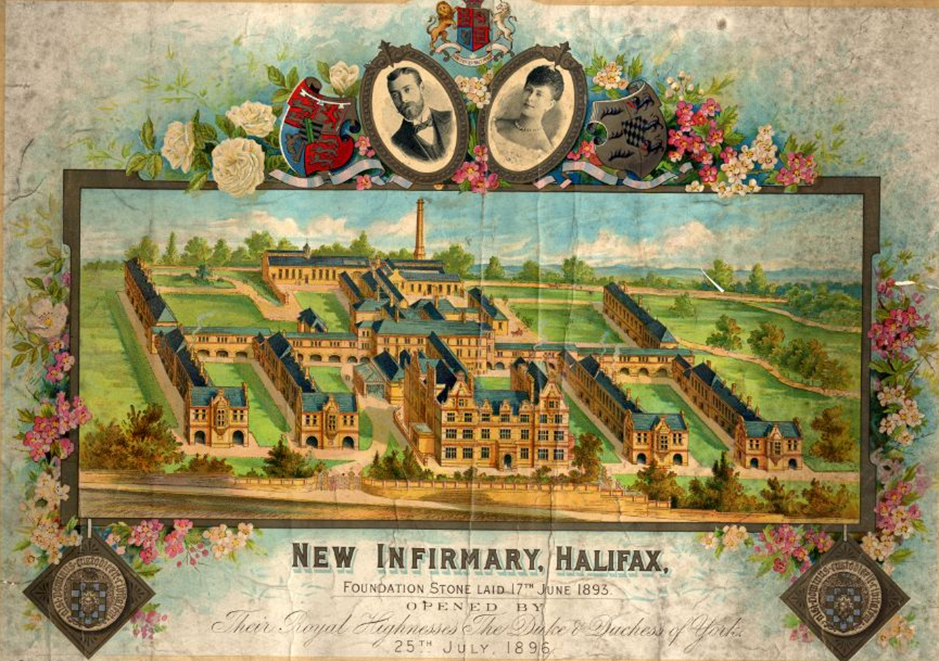
A new, 13 acre site was bought for £14,000 on Free School Lane. The building was to be constructed ‘according to the most approved modern principles, with the best possible sanitation’. It was funded largely through subscription, with gifts of £5000 given by four people to cover the cost of four of the wards. The donors were Mrs Williams of Moor Park, who was the daughter of the late Joshua Appleyard, former Mayor of Halifax and president of the Infirmary board; John and William Baldwin in memory of their father John, co founder of J and J Baldwin, worsted spinners; Sir Savile Brinton Crossley Bart, son of Francis Crossley of Dean Clough and Miss Rawson of Mill House in memory of her Father William Henry Rawson. He had been president of the Infirmary board, and the Rawson family had been benefactors of the Infirmary since its beginning. The wards were therefore named the Joshua Appleton Ward, Rawson Ward, Crossley Wards and Baldwin Ward.
In later years Miss Porter of Savile Royd funded a ward in memory of her family, and Mrs Wood, the daughter of Henry Charles McCrea, another Halifax Mayor funded the McCrea Ward. The six wards had a total of 150 beds.
The foundation stone was laid on 17th June 1893 with a Masonic ceremony and parade.

The building cost over £70,000 to build. It was opened on 25th July 1896 by the Duke and Duchess of York and became known as the Royal Halifax Infirmary.
The 1897 annual report describes the buildings as ‘admirably suitable for their purpose, their advantages alike from the point of view of comfort and of sanitation having been most apparent.’
The report gives a detailed list of expenditure for the day to day running of the Infirmary. Some notable purchases include 17 gallons of spirits (in the category of stimulants for patients), 150 gallons of cod liver oil, 9,753 gallons of milk and 245 tonnes of house coal.
In 1897 1,045 in patents were treated and 3,851 out patients. Some of the most common ailments were Tuberculosis, gastric ulcer, chlorosis and anaemia, mitral incompetence and rheumatism.
The most common accidents treated were wounds of the head and neck, wounds of the chest and arm, fractures of the femur and fractures of the tibia and fibular. They also had three cases of a cut throat with two of the three surviving.
The Infirmary still ran as a charity for those ‘unable to pay for medicine and medical attendance’ with donors/ subscribers having the right to recommend patients. Some people also funded their place through workpeople’s contributions, where a fixed amount was taken from their wage. This stopped in 1938 and a contributory scheme was introduced that wasn’t necessarily connected to their workplace and enabled them and their dependents to receive treatment.
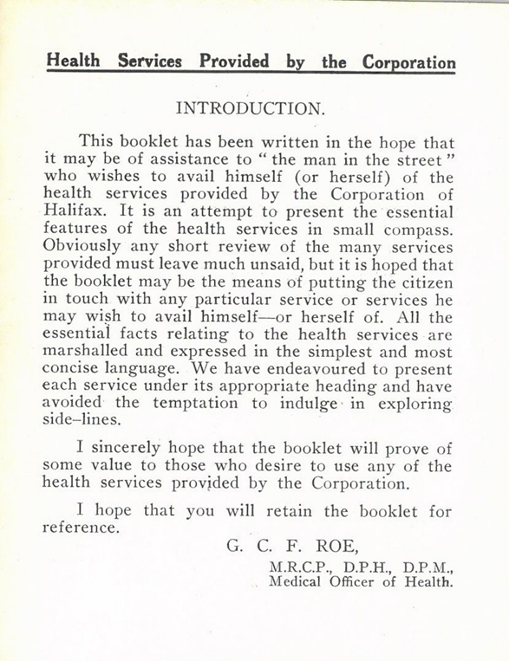
It continued to operate in this way up until the creation of the National Health Service in 1948. The Matron of the Royal Halifax Infirmary, Miss E Kinch said ‘In common with all other hospitals our infirmary is to be absorbed into the National Health Service and will play its part in making the new health service a success’ The creation of the NHS meant that medical care including hospital treatment was free for everyone.
The Infirmary saw many advances in medical care and was expanded several times with additional wards and buildings being constructed and new services offered, including an eye ward, pathology labs, X-ray department, trauma clinic, resuscitation and treatment rooms. It also pioneered one of the first cervical screening and well women clinics in Yorkshire in the 1960s. The 1980s and 1990s saw huge advances in technology with Computerised Tomography (CT scans) launching in Calderdale in 1989 and Magnetic Resonance Imaging (MRI scans) in 1996.
Less than a mile away from Royal Halifax Infirmary was Halifax General Hospital, which had opened in 1901 originally as St Luke’s Poor Law Hospital. This also became part of the NHS and the same hospital trust, so for many years hospital provision was split between the two sites.
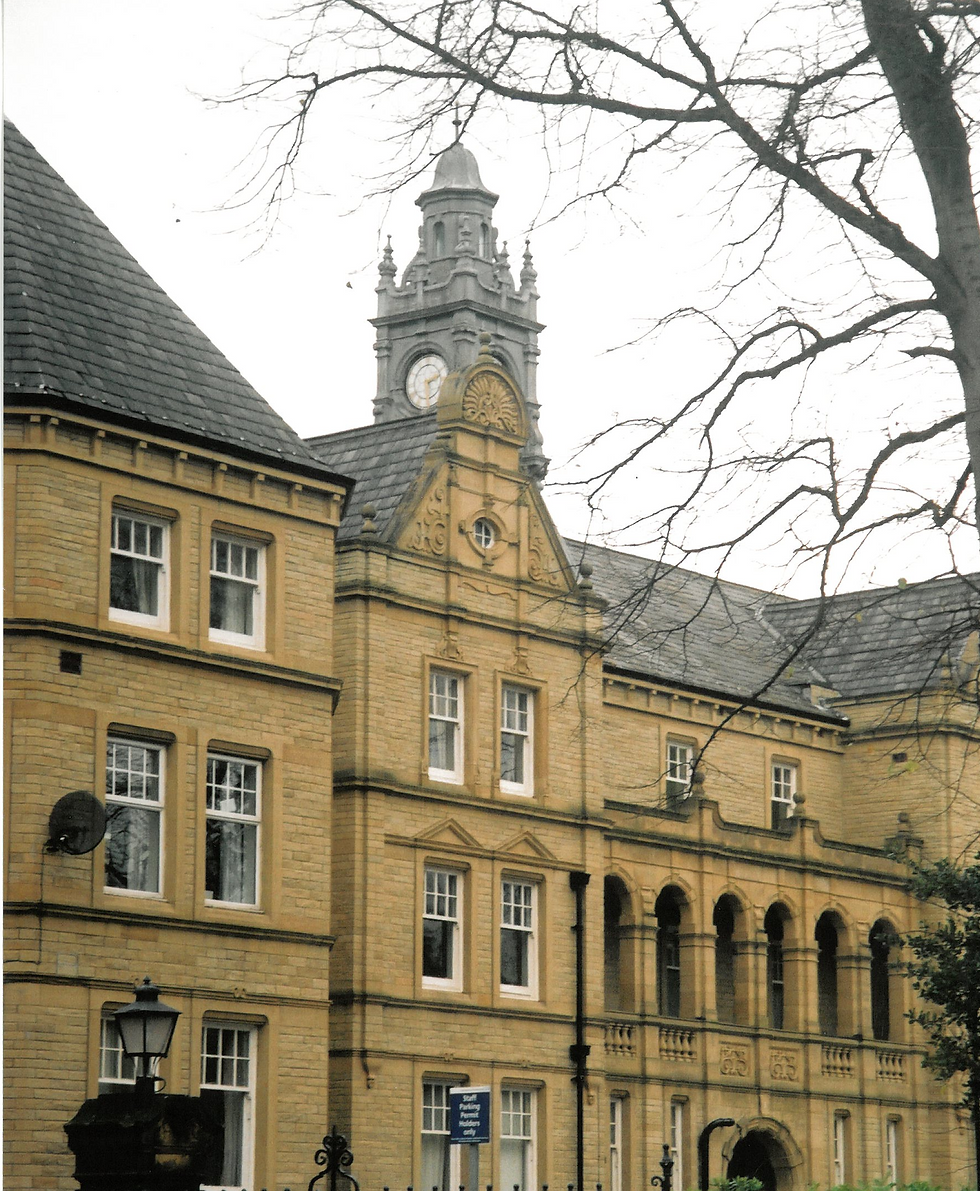
In 1998 a proposal was put forward for the two hospitals to be merged on a new site. In 2001 Royal Halifax Infirmary closed and services were all transferred to the new Calderdale Royal Hospital. Much of the building is now apartments. Calderdale Royal Hospital is part of the Calderdale and Huddersfield NHS Foundation Trust and is currently being re-developed.
References and Further Reading:
Calderdale Healthcare Trust; Redevelopment of Healthcare Services: A Bid for a new hospital in Halifax. June 1998. Shelf No 362 CAL (Large)
County Borough of Halifax; Services Provided by the Corporation; The National Health Service. 1948. Shelf No 1948
Halifax Infirmary; Annual Report. 1859. Shelf No P362
Halifax Infirmary; Rules & Regulations. 1838. Shelf No P362
Halifax Dispensary; Twenty Ninth Annual report of the Halifax General Dispensary 1837 (Handbill No 94)
Halifax Guardian (Available via British Newspaper Archives and on microfilm at Central Library and Archives)
Halifax Infirmary and Dispensary; Report of the committee appointed at the annual meeting of governors of the Halifax Infirmary held on the 30th January 1889. Shelf No P362.
Royal Halifax Infirmary; 100 Years of Caring; the History of the Royal Halifax Infirmary.1996. Shelf No P362
Royal Halifax Infirmary; All About Us 1950. Shelf No: P362
Washington. J.G; The Origins and Development of the Royal Halifax Infirmary, Transactions of the Halifax Antiquarian Society. 1996. Shelf No. 942.3746 HAL


Comments